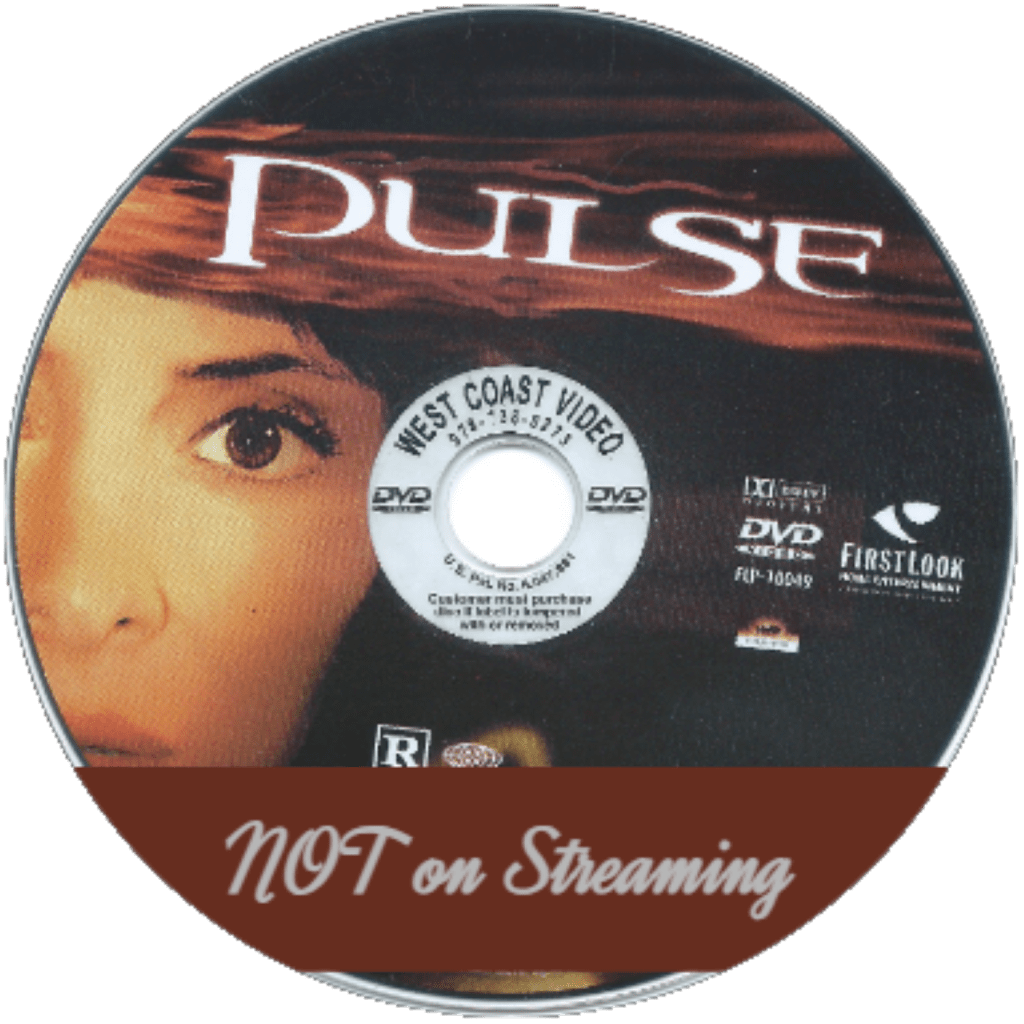
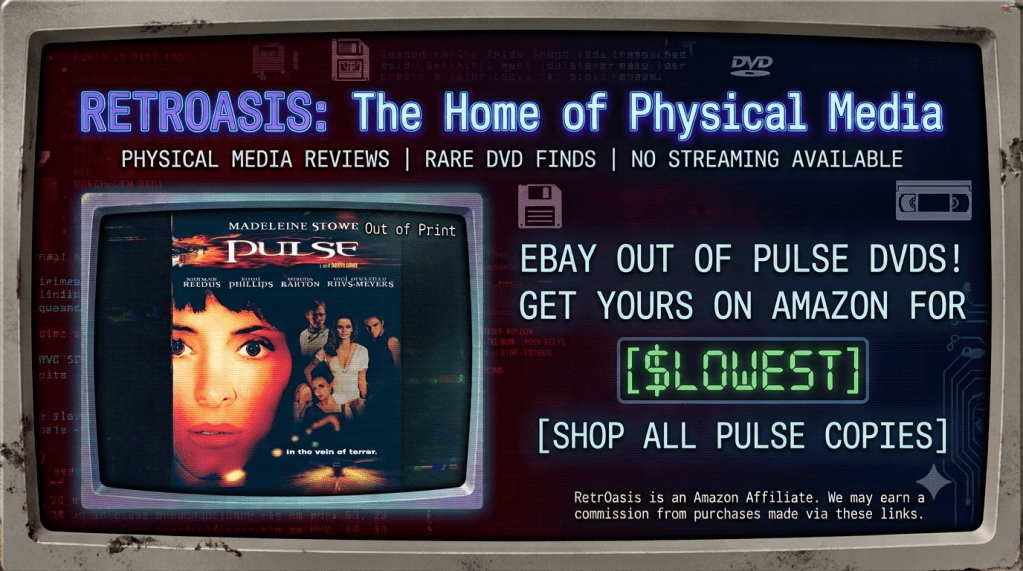
• Welcome back to the RetrOasis. Today, we are hitting the pavement on a near-deserted highway with a 2003 psychological road-horror trip that goes by two names: “Pulse” in the US, and “Octane” internationally.

    Let’s lay my cards on the table: I love Madeleine Stowe. This movie catches her right at her peak acting era. On top of that, I am a massive The Walking Dead fan, and I have an absolute fascination with movies and TV shows about cults and the weird, terrifying control they exert over their followers. So, finding this rare disc had me primed and excited for a quirky, nightmarish road picture.

    The reality? Well… let’s just say I might have been brainwashed by a cult halfway through, because 24 hours later, the plot completely evaporated from my brain.

    The Setup: Goths, Gas Stations, and Gore Subtext

    The movie follows Senga Wilson (Stowe), a divorced mother driving overnight down a desolate highway with her rebellious teenage daughter, Nat, played by a pre-The OC Mischa Barton. After a tense pit stop, Nat gets lured away by a charismatic, goth-like, blood-obsessed group of wanderers driving a black muscle car. Suddenly, Nat vanishes into the night, leaving Senga to hunt for her across an increasingly surreal American roadside.

    As a parent, that is pure nightmare fuel. And to be fair, parts of this flick are genuinely creepy. It maintains a constant, heavy vibe of uncomfortableness that keeps you on edge. Senga encounters menacing hitchhikers, a bizarre doctor, and an endless string of medical imagery—syringes, transfusions, and blood addiction.

    The Luxembourg Deception

    Here is a wild bit of trivia for you: despite being marketed as a gritty, neon-soaked American interstate thriller, this movie was shot almost entirely in Luxembourg.

    The production team got their hands on a brand-new, unopened 12-kilometer stretch of European highway and dressed the diners and truck stops to look like the US. That actually explains the movie’s most unique feature: the roads are completely depopulated. There are almost no other cars on the road, intensifying the feeling that Stowe is driving through a liminal limbo state rather than a real country.

    To back up that club-like, drug-trip atmosphere, the director brought in the legendary British electronic duo Orbital to do the score. The pulsing, minimalist electronic tracks give the film a hypnotic, trance-like rhythm that keeps you trapped in the car with Senga.

    Why it Lost the Plot

    So, what went wrong? Pulse actually spent five years in development as a traditional, fangs-and-coffins vampire flick. But when director Marcus Adams took over, he spent a year stripping out the conventional monster rules. He turned the vampirism into a metaphor for youth subcultures and predatory manipulation.

    While I appreciate the artsy, “faint vampire” subtext, the narrative clarity completely collapses under its own weight. It took me several attempts just to get through it. For every scene that works—like the very sharp, cutting ending—there’s a sequence that just drags.

    And for my fellow Walking Dead fans looking to see a young Norman Reedus? He’s in here, but adjust your expectations. He is miles and miles away from his iconic Daryl Dixon character.

    Why It’s a RetrOasis Resident

    • The Name Game Confusion: When it hit the US, they changed the title from Octane to Pulse. This proved to be a terrible marketing move, as it immediately got confused with Kiyoshi Kurosawa’s Japanese horror masterpiece Kairo (also released as Pulse) and its later Hollywood remake. It completely buried the film’s identity.
    • The Streaming Blackout: As of 2026, Pulse/Octane has been thoroughly ghosted by the major legal streaming platforms. It’s a textbook Euro-horror oddity of the early 2000s that only exists if you can track down the physical DVD.
    • The Verdict: I give it a C-. I can’t wholeheartedly recommend it unless you are a die-hard Madeleine Stowe completist, a Norman Reedus stalker, or you have taken a sacred blood oath to watch every single film ever made about cults. It has a great atmosphere, but it sorely needed a more riveting story and a better flow.

    If you do manage to find a copy at a flea market, pop it in your DVD player just to experience Orbital’s hypnotic soundtrack against those weirdly empty Luxembourg roads. Just don’t expect to remember what happened the next morning.

    What’s your favorite “style over substance” horror movie? The kind where the plot makes zero sense but the vibe is immaculate? Let’s talk in the comments!

    #RetrOasis #Pulse2003 #OctaneMovie #MadeleineStowe #NormanReedus #PhysicalMedia #LostMedia #CultHorror #MaineMoviePirate

  • Welcome back to the RetrOasis. Today, we’re looking at a finale that still hits right in the solar plexus—even thirty-six years later. I’m talking about “The Death of the Incredible Hulk” (1990).

    I’ve always loved the Hulk, from the classic Kirby comics to the campy fun of the MCU, but there’s something about the Bill Bixby era that just feels different. Spinning the rare disc for this review was a bittersweet experience, and honestly, it’s a time capsule of an era that was closing its doors forever.


    The Setup: David Bellamy and the Lab of Last Resort

    The movie opens with our favorite fugitive—calling himself “David Bellamy” this time—working as a janitor. It’s the classic Hulk trope: David has found a new lab, a new mentor (Dr. Ronald Pratt), and a new sliver of hope for a cure. But David is a perpetual magnet for every two-bit thug and international spy who mistakes a quiet man in a janitor’s uniform for an easy target.

    Things go south when a spy network (including a character very clearly modeled after the Black Widow) tries to steal Pratt’s research to create an “Army of Hulks.” The plot drones on like a long, high-stakes episode of the TV show, culminating in a “Hulk out” that feels heavier than usual.

    Why This Finale Hits Harder

    What makes this movie stand out isn’t the action—it’s the somber, almost melancholy tone. Unlike the previous TV movies (The Incredible Hulk Returns and The Trial of the Incredible Hulk), this one ditches the hokey superhero cameos (sorry, Thor and Daredevil) for a serious spy-thriller vibe.

    • The Tragedy: The ending is legendary. No spoilers, but the title isn’t lying. For a character who had previously survived impossible falls and tank shells, the final scene feels less like a failure of physics and more like a deliberate emotional choice. David Banner is finally, tragically, at peace.
    • The “What If”: There were plans for a follow-up called The Revenge of the Incredible Hulk, but Bill Bixby’s real-life illness and the movie’s definitive ending stopped it in its tracks. This really was the end of the road.

    The Production Grind

    Shot in Vancouver, this was Bill Bixby and Lou Ferrigno’s third and final TV movie collaboration. It’s amazing to think this was nearly an Iron Man or Black Widow spin-off! You can see the DNA of those Marvel characters in the script, even if they couldn’t get the rights to use the names back then.


    Why It’s a RetrOasis Resident

    • The “AWOL” Streaming Status: Don’t go looking for this on Disney+ or Netflix. As of 2026, The Death of the Incredible Hulk is effectively missing from the major legal streaming platforms. It’s a victim of complex rights issues and its status as a “made-for-TV” relic.
    • The Physical Media Quest: If you want to see David Banner’s final bow, you’re going to have to hit the thrift stores or dig through your old DVD collection. The 2003 DVD release is becoming a “white whale” for collectors.
    • The Verdict: It’s a solid B+. It lacks the “smash” spectacle of a modern MCU flick, but it has ten times the heart. It’s a fitting, exhausting, and emotional goodbye to a character we all grew up with.

    Go find that disc, dust off the player, and give the Hulk one last hurrah. Just don’t make him angry… you might not like the ending.


    Do you think the MCU should bring back the “fugitive on the run” vibe for the Hulk, or is the “Science-Bro” version here to stay? Let’s hear it in the comments!

    #RetrOasis #TheIncredibleHulk #BillBixby #LouFerrigno #PhysicalMedia #LostMedia #MarvelHistory #HulkSmash

  • Hey! you found your way back to the RetrOasis. Today’s entry is a journey into the deep, dark cracks of the 2000s direct-to-video boom. We’re looking at “Hell House: The Book of Samiel” (2008)—also known as The House on Devil’s Road, a title that sounds like it was generated by a horror-movie Mad Libs.

    I really wanted to like this solid indie effort. I truly did. And at times? I actually did! But… well, let’s just say that “but” is going to be doing a lot of heavy lifting by the end of this review.


    The Setup: Tarot, Bugs, and… Rambunctious Scenes

    The plot is your classic “four twenty-somethings break into a haunted house” setup. This time it’s the Shively House in Livermore, California, where an ancient demon named Samiel (a riff on the archangel of death, Samael) is waiting to ruin everyone’s weekend.

    The movie starts slow—really slow. There are a lot of “explainers.” You know the type: where the characters tell you everything instead of the movie showing you. It’s the cardinal sin of creative writing, but hey, when you’re working with a $200,000 budget, sometimes talking is cheaper than monster suits.

    That said, when the movie goes for it, it really goes for it.

    • The “Creepy” Factor: There’s an oral sex/gas kill scene that is legitimately unsettling.
    • The “Rambunctious” Factor: The sex scenes are… well, let’s call them high-energy.
    • The Bug Scene: “They’re just bugs!” Classic line. It actually works!

    A DIY Grindhouse Fever Dream

    Director Jason D. Morris was clearly aiming for a 70s grindhouse aesthetic. The practical effects are a mixed bag—some are surprisingly creative (like the possessed characters reenacting historical flashbacks in sync), while others feel like they were filmed in a basement with a flashlight.

    The production was apparently cursed in real life, too. The editor claimed they lost multiple sequences due to hard drive failures, which forced them to hastily reshoot filler scenes. If you’re wondering why the movie feels disjointed and the tone shifts like a manual transmission with a bad clutch, now you know why. It’s the digital equivalent of “the dog ate my homework,” but with demons.


    Why It’s a RetrOasis Resident

    • The “Baffling” Soundtrack: The opening features an obscure track called “Sexual Vampire” by Chris Heaven. If that doesn’t tell you exactly what kind of ride you’re in for, nothing will.
    • The 2.2 IMDb Score: Look, a 2.2 rating is usually a warning sign, but in the RetrOasis, it’s a badge of honor. It means the movie was too weird, too raw, or too chaotic for the mainstream.
    • The Streaming Void: As of 2026, Hell House: The Book of Samiel is nowhere to be found on the big streamers. It’s a relic of the “Brain Damage Films” era—a time when independent distributors could get almost anything onto a video store shelf.

    The Verdict: A Mixed Bag in the Dark

    I’ll admit it: I dozed off at one point. But—and here is the rare part—the movie actually gets better as it goes on. The ending is creepy, fast-moving, and actually lands a punch.

    Is it a masterpiece? No. The good scenes are often outweighed by the disjointed storytelling and some “experimental” flow that doesn’t quite land. But as a time capsule of underground, defiantly independent horror? It’s a fascinating, messy ride. I’d give it a C- for the effort and that “Sexual Vampire” energy.

    If you find this one on a dusty DVD Thrift store shelf, grab it. It’s a reminder of a time when horror was DIY, ambitious, and totally unpolished. Just maybe bring some coffee so you don’t doze off during the explainers!


    Have you ever watched a movie where the “behind-the-scenes” disasters (like lost footage) were more interesting than the plot itself? Let’s talk about cursed productions in the comments!

    #RetrOasis #HellHouse #IndieHorror #LostMedia #PhysicalMedia #Samiel #Grindhouse

  • Mmmh, it feels good to have you back to the RetrOasis. Today, we’re kicking the piano bench across the room and setting the keys on fire. We’re talking about the 1989 biopic “Great Balls of Fire!”

    The movie opens with a young Jerry Lee Lewis being warned: “Jerry Lee! It’s the Devil’s Music! I can feel it!” With a massive, defiant grin, he shoots back, “YEAH!”

    That one exchange pretty much sums up this loud, brash, and unapologetic look at “The Killer.” It’s a movie that matches its subject perfectly—it’s messy, it’s charismatic, and it’s impossible to ignore.


    The Story: A 1950s Fever Dream

    The film captures the explosive rise of Lewis (played with high-voltage energy by Dennis Quaid) at Sun Records in Memphis. He wasn’t just trying to play music; he was trying to outshine Elvis and turn every stage into a riot.

    But as fast as the success came, the downfall was even quicker. The emotional—and controversial—center of the film is his marriage to his 13-year-old cousin, Myra Gale Brown (Winona Ryder). The movie presents this as a collision course between fame, religion, and a public that turned him into a pariah overnight.

    Production and “Phoney” History

    Based on the autobiography by Myra Lewis herself, the film didn’t exactly have a smooth ride. Jerry Lee Lewis actually advised the production and rerecorded his hits for the soundtrack, even though he reportedly hated that the source material came from his ex-wife’s book.

    Was it accurate? Honestly, I don’t know if that matters. One of the co-writers actually called the final product “phoney,” and Myra claimed the producers froze her out of the script process. To me, it feels like a representation of the 1950s seen through a distorted, Lewis-style lens. Some sequences feel more like 80s music videos than a cohesive story, but it works.

    Performance vs. Scandal

    Both Quaid and Ryder are great actors, and they have moments—like the “fear of the bomb” scene—where their real potential shines through. Unfortunately, those moments are often overshadowed by some pretty hokey lines and a delivery that feels a bit “cartoony” at times.

    The marriage scandal is the heavy focus here, and it’s likely why the movie flopped in the late 80s. Looking at it through a 2026 lens—in a world of “Me Too” cases and Epstein-tainted politics—the 1950s outrage portrayed in the film almost feels a bit over the top. But then again, everything about Jerry Lee was over the top.


    Why It’s a RetrOasis Resident

    • The “Killer” Soundtrack: Jerry Lee rerecording his own classics specifically for this movie makes the audio a unique artifact. You aren’t just hearing old masters; you’re hearing the man revisit his youth.
    • The Streaming Stand-Off: As of 2026, Great Balls of Fire! is playing hard-to-get with the major streaming services. Between music licensing and the “touchy” subject matter of the plot, it’s a prime candidate for the RetrOasis.
    • The Verdict: If you love the music, you have to see this. It captures the danger and absurdity that made rock-and-roll feel like a threat back in the day. It’s a solid B for the energy alone.

    Goodness gracious, don’t bother checking the streams! This one is currently strictly on VHS, Blu-Ray, and DVD. We still have RetroMedia, and thank the Devil for that!


    Do you think biopics should stick to the facts, or is the “vibe” more important when portraying a legend like the Killer? Let’s hear it in the comments!

    #RetrOasis #GreatBallsOfFire #JerryLeeLewis #PhysicalMedia #DennisQuaid #WinonaRyder

  • Welcome back to the RetrOasis. Today, we’re tackling a title that might give you a bit of cinematic PTSD just by looking at it. I’ll be honest: there are two movies in my life I’ve started, stopped, and flat-out refuse to ever touch again. Cannibal Holocaust (the tortoise scene—I just can’t) and The Human Centipede.

    The good news? Those “classics” are well-represented on streaming, so I don’t have to watch them for the blog. The bad news? Today’s required viewing is “The American Poop Movie” (2006).

    I dived in hesitantly, fearing the worst, but I’m happy to report that while the title isn’t exactly misleading, it’s a bit of a head-fake. Yes, there are poop jokes. Yes, there are enough random fart gags to fill a stadium. But underneath the gross-out exterior, there’s a solid indie heart beating in there.


    The Setup: The Anti-Coming-of-Age Story

    Originally titled “Now What?” (and bafflingly marketed in Thailand as “Dorm Daze 4”), the film follows Russ, a post-college slacker drifting through the gray reality of East Granby, Connecticut. After graduation, the dream of his own TV show vanishes, leaving him stuck in dead-end jobs and awkward run-ins with his past.

    For me, this hit close to home. The plot—someone who had early Public Access success but struggled to make it in corporate media—is a real-life chapter I’ve lived. Watching Russ navigate that “what now?” frustration felt less like a raunchy comedy and more like a documentary with a few extra fart sound effects.

    The Connecticut Connection

    This isn’t a Hollywood production. Directed by Joe Kingsley, this was a homegrown labor of love filmed around Windsor Locks and Simsbury. It relies heavily on local spots and probably a fair few of the director’s friends. That scrappy, regional energy gives it a “Poor Man’s Animal House” or Old School vibe. It’s got that raw, mid-2000s indie spirit that feels totally extinct in today’s polished, algorithm-driven world.

    The Weirdness Factor

    • The Final Punchline: Most gross-out comedies end with a party. This one? Without spoiling too much, it ends on a surprisingly bleak note at a crossroads that turns the whole crude journey into a strangely dark final joke.
    • The “Sin” Scale: This movie is incredibly low on the Political Correctness scale. Does that scale even exist anymore? Probably not, which is exactly why this film has vanished from the mainstream.

    Why It’s a RetrOasis Resident

    • Streaming Status: As of 2026, The American Poop Movie is ghosting the major streaming services. It’s a “non-streamer” through and through. Between the spotty music rights and the aggressively lowbrow humor, it’s just not built for the modern subscription landscape.
    • The Sparse DVD: The original DVD release from Peace Arch Entertainment is becoming a rare find. Collectors are snapping them up, and for good reason—it’s a time capsule of a specific, unapologetic era of filmmaking.
    • The Verdict: It’s not for everyone. If you can’t handle a well-timed (or poorly-timed) fart joke, move along. But if you appreciate a movie that tells you exactly what it is on the label and manages to be a surprisingly relatable look at post-college failure, give it a shot.

    Take it from me: The American Poop Movie doesn’t actually stink. It’s a solid B- for the indie effort alone. Grab a physical copy while you still can!


    Has anyone else lived the “Public Access to Corporate Media” struggle like Russ and I? Let’s talk about it in the comments!

    #RetrOasis #IndieHorror #GrossOutComedy #PhysicalMediaForever

  • Today at the  RetrOasis, we’re dusting off a 1985 classic that proves some of the best loves aren’t found in a catalog—they’re found in the passenger seat of a broken-down car.

    I’m talking about Rob Reiner’s “The Sure Thing.”

    I vaguely remember seeing this in theaters when it first dropped. Back then, in the neon haze of the 80s, it probably just felt like another teen sex romp. But watching it again forty years later? It’s a revelation. This isn’t a leering gag-fest; it’s a high-quality, character-driven road movie that owes more to Frank Capra than to Porky’s.


    The Setup: From “Sure Thing” to Real Thing

    The plot is classic 80s simplicity: Boy meets Girl, Girl thinks Boy is a total pig. John Cusack (in his first major starring role) plays Walter “Gib” Gibson, a glib freshman who’s tired of the East Coast winter and his own lack of “luck.” When his buddy Lance (Anthony Edwards) calls from California promising a “Sure Thing”—a no-strings fantasy girl played by a young Nicollette Sheridan—Gib is gone.

    The catch? He’s stuck sharing a ride with Daphne Zuniga’s Alison Bradbury, a disciplined, uptight “perfect student” heading to UCLA to see her bore of a boyfriend. They despise each other. Naturally, they get abandoned on the side of the road, and the real movie begins.

    The “Fonzie” Connection and Spinal Tap Easter Eggs

    Keep a sharp eye for the credits! While Henry Winkler (the legendary Arthur Fonzarelli) isn’t listed as the main producer, his production company, Fairview Productions, was involved, and the film was actually Executive Produced by Henry Winkler. Yes, the Fonz helped get this love story to the screen!

    The movie is also a time capsule for director Rob Reiner. Fresh off This Is Spinal Tap, Reiner couldn’t resist a meta-wink: look closely in Gib’s dorm room and you’ll see a Spinal Tap poster hanging in the closet. It was Reiner’s way of marking his territory as he moved from “actor” to “auteur.”

    And keep your eyes peeled for a young Tim Robbins in an early role as a square, a cappella-singing passenger, and an oddly placed “I Love ET” bumper sticker that screams 1982.

    Why It’s a RetrOasis Essential

    • The Soundtrack Trap: —the music is fantastic, featuring Rod Stewart, Huey Lewis & The News, and The Cars. But here’s the RetrOasis kicker: a soundtrack was never officially released. Because of the massive licensing costs for all those 80s hits, the film has often faced hurdles in the digital age.
    • The “Shotgun” Tutorial: This film features what might be the first (and best) demonstration of “shotgunning” a beer in American cinema. Interestingly, this wasn’t in the script; Cusack told Reiner he actually knew how to do it, and Reiner told him to show Alison.
    • Streaming Rarity: As of 2026, finding “The Sure Thing” on major streaming platforms is, well, anything but a “sure thing.” Licensing shifts and the cost of those 80s pop gems keep it drifting in and out of digital availability.

    The Verdict: Persistence Pays Off

    This movie shows the awkwardness of the teenage years better than almost anything from that era. It’s about the payoff for raw persistence and how love actually forms when you aren’t looking for it.

    If you want to see Gib and Alison fake a pregnancy to get a ride or watch their bickering soften into a genuine connection in a cramped motel room, you might have to dig for the DVD or Blu-Ray. It’s a time capsule worth the effort. Dust off the player—this one is a solid A- that only gets better with age.

    #RetrOasis in the Streams

    #TheSureThing

  • Welcome back to the RetrOasis. Today, we’re digging through the digital mulch to find a 2005 indie relic that proves one thing: if you have a meat cleaver, a welder’s mask, and the “Hedgehog” himself, Ron Jeremy, you can apparently get a movie into Sundance.

    I’m talking about Andre the Butcher (or Dead Meat, depending on which bargain bin you found it in).

    I went into this one blind. Looking at the arty, Euro-trash cover art, I thought I was in for a raw, edgy, European-style portrait of a serial killer. I was asking myself: How did this indie foreign flick land a massive American “star” like Ron Jeremy?

    I was wrong. So, so wrong.


    The Setup: Cheerleaders and… Dingleberries?

    The “plot”—and I use that term loosely—follows four junior college cheerleaders who crash their car in rural Florida. Standard slasher geography, right? But before the blood starts flowing, we have to endure these characters being obnoxious for scene after scene.

    The “dingleberry” on top? This incredibly annoying stud character who loves the word “dingleberry” so much he says it three times. Three! That’s a high density of dingleberries for an 80-minute runtime. Now he’s got me saying it. God help us.

    The Meat of the Matter

    When the killer finally strikes, it’s our boy Ron. He plays Andre as an unstoppable, invulnerable, supernatural force who can re-attach his own limbs like a gory Lego figure. At first, it feels like a total Troma-style trash comedy—crass humor, sleazy sheriffs (who are often more depraved than the monster), and “Cops”-style fugitive chases.

    But then, the movie actually gets good. Usually, I hate origin stories. I hate the “explainer” that strips away the mystery. But Andre’s flashback—the 1950s family man driven insane by tragedy who starts selling “special” meat—actually works. It explains his role as a sort of “Infernal Recruiter” for the Devil, tasked with harvesting sinful souls. The movie even literalizes this by having a TV monitor broadcast the characters’ “sins” (gluttony, lust, etc.) right before they get the cleaver. It’s a weirdly pointed satire of reality TV confessional culture tucked inside a horny, gory cartoon.

    The “Holy Water” Incident

    If you want to know exactly what kind of movie this is, look no further than the climax. How do you defeat a demonic butcher? Holy water. But when the jugs break, an escaped convict/lapsed priest named Hoss has to… improvise.

    He uses his own urine, blesses it mid-stream (while the final girl aims for him because he’s too weak to hold it), and the “sacrament” actually works. It’s blasphemous, juvenile, and arguably the most “2000s direct-to-DVD” moment in cinematic history.


    Why It’s a RetrOasis Resident

    • The Streaming Void: You won’t find Andre on Netflix or Max. This is a physical media exclusive. It’s a “DIY curiosity” that thrived on the mid-2000s DVD boom when collectors were hungry for anything with a flashy cover and a recognizable name.
    • The Rebranding Madness: In Germany, they released this as “House of the Butcher 2” despite there being no part one. It’s that kind of beautiful, chaotic marketing that we just don’t see in the era of “Algorithm-Approved” titles.
    • The Verdict: Is it a good film? No. It’s a solid C-. It’s a patchwork effort—Ron Jeremy isn’t even in the suit for half the shots—but the origin story and the sheer audacity of the “urine exorcism” give it a weirdly infectious charm.

    With a bit more creative storytelling and a few less dingleberries, this could have been a B+ cult classic. As it stands, it’s a fascinating, foul-mouthed time capsule of a time when indie horror was trying to be Scream and The Texas Chain Saw Massacre at the same time, while drunk on cheap beer.

    #RetrOasis in the Streams

  • Alright, fellow explorers of the digital wasteland, pull up a chair. Today’s “RetrOasis in the Streams” entry is a truly special find. We’re diving headfirst into the abyss, or rather, “Hell and Back,” the 2015 stop-motion animated black comedy that, if you’re like me, you’ve probably never heard of. And that, my friends, is precisely why it’s landed squarely in our “only on retro media” spotlight.

    I stumbled upon this gem – in almost pristine DVD condition, no less! – at one of those magical yard sale/thrift store/flea market hybrids. You know the kind, where the air hums with the promise of forgotten treasures. As a huge fan of the adult animation ecosystem – think “South Park,” “Rick & Morty,” “Robot Chicken” (and fun fact, the creators of this very film cut their teeth on “Robot Chicken”!), I was salivating like Pavlov’s dogs. A decade-old, obscure stop-motion adult comedy? Sign. Me. Up.

    What in the “Hell” is This Movie?

    “Hell and Back” is a 2015 creation from the minds of Tom Gianas and Ross Shuman, brought to life by ShadowMachine Films, the same folks who gave us “Robot Chicken.” It boasts a surprisingly star-studded voice cast: Nick Swardson, Mila Kunis, Bob Odenkirk, T.J. Miller, Rob Riggle, Susan Sarandon, and Danny McBride. That’s a serious lineup for a film you’ve likely never encountered.

    The premise is gloriously absurd: three carnival worker buddies – Remy, Augie, and Curt – are trying to save their crumbling carnival. Remy, in a moment of desperation (and maybe a little misguided genius), borrows a spell book. A petty argument over a mint leads to a blood oath, and poof! Curt gets sucked straight into Hell. Naturally, his two best buds follow, embarking on a rescue mission through a truly bizarre, grotesque, and frankly, hilarious underworld.

    Along the way, they encounter everything from the Devil himself (voiced by the inimitable Bob Odenkirk, naturally) to a half-demon named Deema (Mila Kunis, who, bless her, was intentionally crafted to be both fearsome and sympathetic – a true Hell denizen duality), and even a washed-up, slacker Orpheus (Danny McBride, perfectly cast). It’s a journey filled with crude humor, surreal takes on mythology, and enough anatomical absurdity to make your grandma blush.

    Why Was This Obscure Gem Hiding?

    Here’s the rub, and why “Hell and Back” fits perfectly into our “RetrOasis” theme: this film barely saw the light of day. Distributed by Freestyle Releasing, it had a ridiculously limited theatrical run and practically zero marketing. It sputtered at the box office, raking in a measly $157,768. Ouch.

    And as of 2025, you won’t find “Hell and Back” gracing the digital libraries of your major streaming platforms. Nope. This bad boy is firmly rooted in the physical realm. If you want to experience the visual spectacle of animated pizza delivery mishaps in Hell or hear H. Jon Benjamin voice a “Sex Offender Tree” (yes, you read that right), you’re going to have to go old school. Dust off that DVD player. Hit up those yard sales. This is a true “RetrOasis” resident – a film you can only find by going off the beaten digital path.

    My First Trip Through the Underworld (and Why It’s Stuck There)

    As I mentioned, my initial anticipation for “Hell and Back” was through the roof. I mean, adult stop-motion, stellar voice cast, and a premise that screams “late-night genius”? I wanted to love it. And to be fair, there are genuinely laugh-out-loud moments. The “pizza delivery in Hell” gag is fantastic, and the overall concept of Hell as a mundane, bureaucratic nightmare is pretty clever. It’s got that “Robot Chicken” sensibility, for sure.

    But here’s my honest take, and why I think this film remains firmly in the realm of obscurity: it’s an incredible mixed bag of brilliant and… well, baffling. For every clever jab at religious mythos or genuinely funny character interaction, there’s a heavy dose of what felt like lazy, even uncomfortable, writing. The toilet humor, particularly some of the more explicit “male-on-male rape” jokes, felt less edgy and more “junior high locker room” cringey. It pulled me right out of the narrative.

    The core story – rescuing Curt from Hell while being trapped in it themselves – had so much potential to delve deeper into the mythology of the underworld, to explore more creative punishments, like “Rick and Morty” does with its insane dimensions. Instead, it often felt like it settled for the lowest common denominator.

    The Verdict for Our RetrOasis

    “Hell and Back” is a fascinating artifact of mid-2010s adult animation. It’s ambitious in its visual style and its willingness to go there with the humor. But it’s also a clear example of how even a fantastic premise and a great voice cast can get bogged down by uneven writing.

    For our “RetrOasis in the Streams” mission, it’s a solid C. It’s absolutely worth seeking out for its rarity, its unique stop-motion style, and the sheer audacity of its premise. It’s a testament to the risks taken in independent animation. But a little more creative storytelling effort, a little less reliance on shock value for shock value’s sake, and this could have easily been a B+ and maybe, just maybe, found the wider audience it aimed for. So, go forth, my friends. Seek out this DVD. Experience “Hell and Back” as it was truly meant to be seen – on a physical disc, a relic from a time when not every film had to fight for digital real estate. Sometimes, the most interesting journeys are the ones that take you “off-stream.”

    #RetrOasis in the Streams

  • Buckle up, fellow retro-nauts, because tomorrow, April 29th, 2025, something… significant is happening. The cinematic artifact known as “The Bermuda Triangle,” the original 1979 pseudo-documentary, is finally breaking free from the murky depths of VHS and surfacing on glorious Blu-ray! Yes, you heard that right. Blu-ray! In this age of instant streaming, they’re dragging this bad boy out on a physical disc. Makes you think, doesn’t it?

    Forty. Years. Forty years this thing has been lurking in the shadows since its grainy VHS release back in ’85. Forty years of digital silence! You can watch every cat video ever made in HD from your phone, but this slice of peak 70s paranoia has been locked away. Coincidence? I think NOT.

    What were they hiding? What secrets are embedded in that vintage footage that they didn’t want our easily influenced modern minds to grasp? Think about it. The Bermuda Triangle. Vanishing ships, lost planes… whispers of Atlantis, maybe even… aliens. And for four decades, the only way to glimpse this “truth” was through a worn-out VHS tape that probably chewed itself halfway through Flight 19.

    Now, here’s where it gets even spookier. Our source material mentions a “2017 Restoration.” Restoration? What needed restoring? Was the original too… revealing? Did they have to scrub out some inconvenient truths about underwater energy crystals or maybe a fleeting glimpse of a shimmering UFO portal? They call it “restoration,” I call it redaction! What subtle changes have they made? What inconvenient “facts” have they smoothed over for our “protection”? We need to be vigilant, my friends. Compare the frame rates! Analyze the color palettes! Are the Atlantean laser beams less laser-y?

    This 1979 masterpiece, narrated with utmost seriousness by Brad Crandall, throws everything at the wall. We’re talking dramatic reenactments that probably had the actors genuinely fearing for their lives (or at least their careers), ghost ships piloted by spectral Dutchmen, and enough eyewitness accounts to make your head spin faster than a compass in the Triangle itself.

    But then… then it goes full tilt into the really juicy stuff. Time warps? Check. Ancient Atlantean tech blasting unseen rays? Double-check (with suspiciously familiar footage from “Atlantis, the Lost Continent,” mind you – budget constraints or clever disinformation?). And yes, they go there. UFOs using the Triangle as a cosmic pit stop. You can practically hear the tin foil hats crinkling in the audience.

    And the sources! Oh, the reliable sources! They’re quoting Edgar Cayce, the sleeping prophet whose track record on, well, anything is about as accurate as a weather forecast in the Bermuda Triangle. And they’re name-dropping figures linked to the Philadelphia Experiment! You know, that little government oopsie where a warship supposedly vanished into thin air? They’re not just exploring a mystery; they’re connecting dots that maybe… shouldn’t be connected.

    The official narrative calls this “sensationalism over science.” They say it’s “fact-deficient.” But what if the “facts” they’re pushing are the real fiction? What if this film, in its glorious, low-budget, melodramatic way, stumbled upon something they didn’t want us to know?

    This Blu-ray release isn’t just a chance to see some wonderfully cheesy 70s special effects in slightly higher definition. It’s an opportunity to revisit a time when the unexplained was embraced, when paranoia was practically a national pastime, and when a documentary could seriously suggest that aliens were using a patch of ocean as their personal drive-thru.

    So, tomorrow, when “The Bermuda Triangle” surfaces from its 40-year exile, are you going to blindly accept this “restored” version? Or are you going to watch with a critical eye, a healthy dose of suspicion, and maybe a tinfoil-lined Blu-ray player, just in case?

    I know what I’ll be doing. The truth is out there… somewhere between the shaky reenactments and the suspiciously clear Blu-ray transfer. Let the deep dive into the RetrOasis begin!

    #RetrOasis

    #bermudatriangle

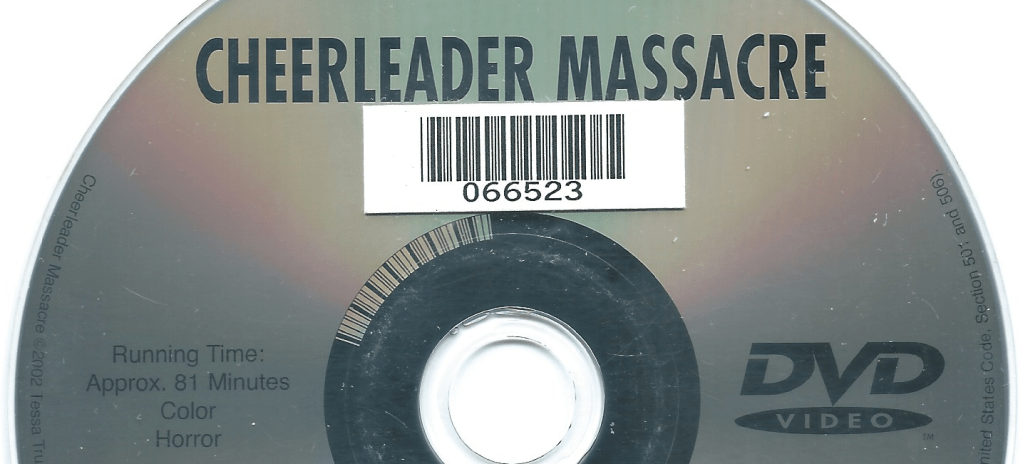
  • Okay, so tonight’s little dip into the retro-streams brings us to a flick that screams “early 2000s direct-to-DVD horror” louder than a… well, a cheerleader at a pep rally facing a masked killer. We’re talking about 2003’s “Cheerleader Massacre.”

    Now, if you’re scrolling through your favorite streaming service, don’t bother looking too hard for this one. As of right now, this slice of low-budget slasher goodness seems to be living exclusively in the land of physical media – specifically, that shiny disc we used to call a DVD. Maybe some brave soul out there has a well-loved VHS copy kicking around too, considering the timeline.

    What’s the mayhem about? Classic stuff, really. You’ve got your stereotypical high school cheerleaders, a creepy remote cabin getaway (because where else would these things happen?), and a supposedly escaped mental patient named Jeremiah lurking in the woods. Cue the ominous music and the rapidly dwindling cast!

    Director Jim Wynorski, a name that pops up in the B-movie universe quite a bit, throws us headfirst into the expected tropes. There’s the isolated setting, the rising body count with some… let’s say creative kills, and the frantic attempts by the local sheriff and a deputy to save the day. So far, so slasher 101, right?

    But here’s where “Cheerleader Massacre” decides to spike the punch with a twist. Turns out, Jeremiah isn’t the big bad after all. Nope, the real bloodlust comes from within the pom-pom squad itself! Seems someone’s got a serious grudge and is using this snowy retreat to settle some old scores. It all culminates in a fiery finale that leaves you wondering just how many cheerleaders are left standing.

    Now, about that “RetrOasis” angle. You see, this is the kind of movie that thrived on the DVD format. It was cheap, cheerful (in a gory way), and perfect for a late-night watch with friends. The charm, if you can call it that, lies in its low-budget roots. We’re talking a reported $60,000 budget! That kind of cash doesn’t buy Hollywood polish, and it definitely shows.

    And the little quirks? Oh, they’re gold! Apparently, they straight-up recycled footage from a totally different movie from the ’80s – “Humanoids from the Deep”! Talk about making the most of your budget. Then there’s the whole seasonal rollercoaster – one minute it’s summer vibes, the next a blizzard rolls in. Continuity? Who needs it!

    Let’s not forget the casting choices. Bless their hearts, the actors playing high schoolers definitely look like they’ve seen a few more proms than their characters. And if you’re into that classic exploitation vibe, well, “Cheerleader Massacre” doesn’t waste any time getting to the early nudity. Plus, keep an eye out for a hilarious spelling error in the end credits – “cirminal” instead of “criminal.” It’s these little gems that add to the B-movie charm.

    So, while you might not find “Cheerleader Massacre” gracing the front pages of your streaming platform, tracking down that 2003 DVD offers a genuine retro experience. It’s a time capsule of early millennium low-budget horror, complete with all the glorious imperfections that come with it. Sometimes, you just gotta dust off the old DVD player to unearth these forgotten treasures. It’s a reminder that not everything makes the leap to digital, and sometimes, that’s where the real, slightly cheesy, fun lies.

    There you have it – “Cheerleader Massacre,” a true resident of our RetrOasis, still kicking it on DVD. Who knows what other forgotten flicks are lurking on those shiny discs? Stay tuned for our next retro-stream adventure!

    #RetrOasis #Horror #cult #cheerleaders #massacre