There is a visceral, unfiltered weight to international cinema that Hollywood rarely allows through the studio filter. No glossy color grading to soften the blow. No swelling string section to cue your tears. Just cold, grounded reality where actions carry devastating consequences.
Srđan Golubović’s 2007 psychological thriller The Trap (Klopka) is a textbook masterclass in that tension. Built as a contemporary Balkan reimagining of Dostoevsky’s Crime and Punishment, the film poses an agonizing moral dilemma: What if the only way to save your child’s life was to murder someone else?
Despite screening at over 50 international film festivals, taking home 21 awards, and landing on the nine-film shortlist for the Academy Award for Best Foreign Language Film, The Trap has suffered the ultimate modern fate: complete digital erasure.
If you pull up JustWatch or search domestic streaming catalogs today, its availability across Netflix, Prime Video, Criterion Channel, Tubi, and Apple TV sits at an absolute 0%. It isn’t hidden behind a paywall; the digital storefronts simply forgot it exists.
The Moral Arithmetic of Desperation
The setup avoids the hollow theatrics of a stylized hitman movie. Mladen (played with raw, devastating exhaustion by Nebojša Glogovac) is a regular civil engineer in Belgrade. His wife, Marija (Nataša Ninković), is an English teacher. They live a modest, hardworking life until their young son, Nemanja, is diagnosed with a severe heart condition.
The surgery must be performed abroad. The price tag: €26,000.
In post-Milošević Serbia—a society Golubović himself described as a “moral and existential desert” recovering from war—that sum is an impossible fortune for an ordinary middle-class family.
Then comes the devil’s bargain. A wealthy stranger (Miki Manojlović) approaches Mladen with a simple proposal: kill an untouchable business rival, and the €26,000 is wired immediately.
What makes The Trap so suffocating isn’t whether Mladen pulls the trigger; it’s the psychological decay that follows. Golubović isn’t interested in action set pieces. He shoots on 35mm using telephoto lenses and extreme close-ups, forcing the viewer right into Mladen’s face as his conscience shatters.
The film’s most brutal indictment of economic inequality is captured in a single, quiet detail: Marija’s wealthy acquaintance casually drops €30,000 on an antique picture frame—not the artwork, just the carved wood around it. In the same city, a child’s life hangs on a €26,000 medical bill.
As the tension tightens, a single piece of sparse dialogue cuts right to the bone:
“He had a seizure, while you were getting dirty.”
Once the moral compass breaks, the slide never stops.
The Physical Artifact: A Blockbuster Survivor
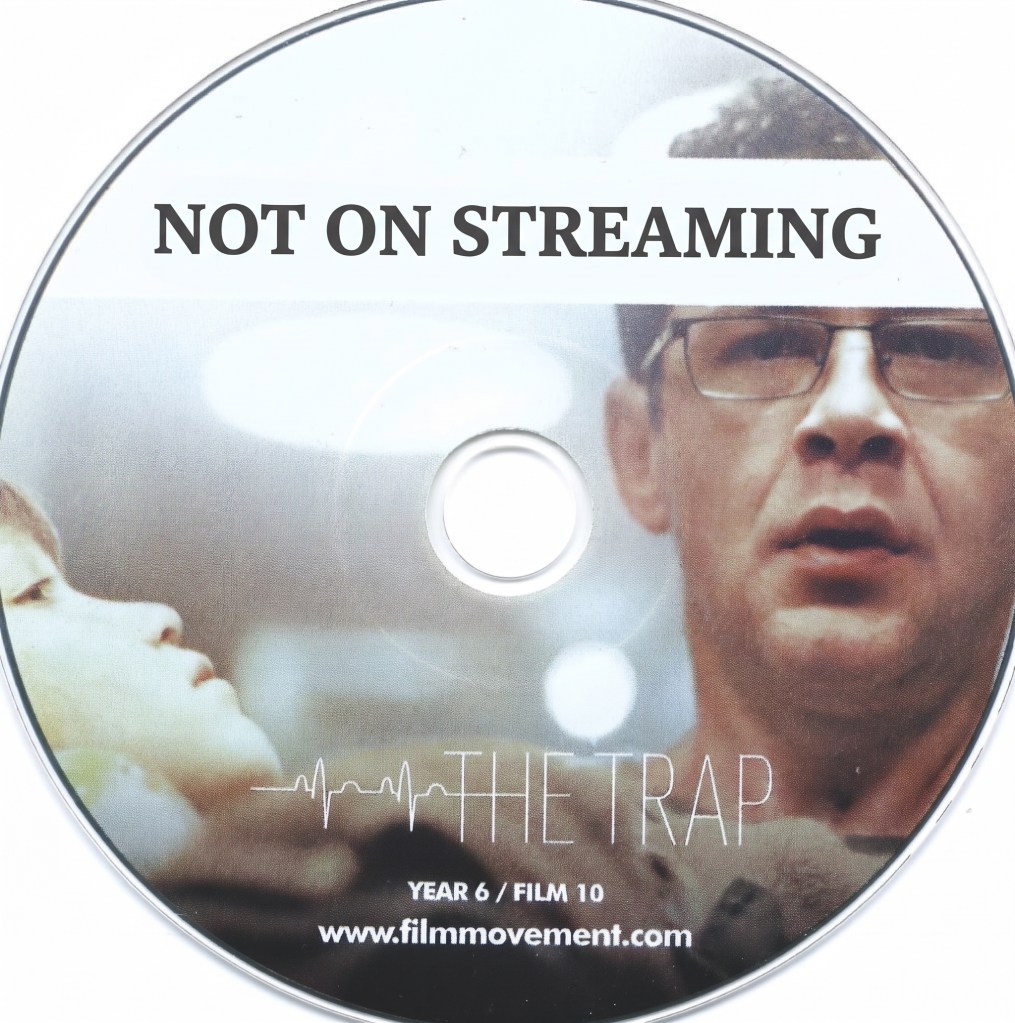
Because The Trap has slipped entirely out of circulation, the only way I was able to experience it this week was through a physical artifact: an original 2008 Film Movement DVD release (Year 6, Film 10), discovered resting inside a heavy-duty, unbranded Blockbuster rental case.
Back in 2008, when rental stores were still battling the early days of DVD-by-mail, boutique distribution outfits like Film Movement partnered with rental chains to put award-winning world cinema onto suburban shelves. They even pressed bonus content directly onto the disc—in this case, Peter Kaboth’s animated short Fallen, another piece of screen history you will never find indexed on a major streaming algorithm.
That heavy plastic rental shell kept the disc alive long after the boutique licensing rights quietly expired.
The Forensic Audit: The “Expired License” Black Hole
The irony of The Trap is that it wasn’t always invisible. Between 2015 and 2021, the film had brief, legitimate digital runs on Netflix, Prime Video, MUBI, and Kanopy.
Then, one by one, the territorial licensing windows lapsed.
Because boutique foreign cinema doesn’t generate subscription churn for multi-billion-dollar tech platforms, no studio executive stepped up to re-clear the contracts. The title wasn’t “banned” or “suppressed”—it was simply abandoned. When an international production doesn’t get folded into a massive conglomerate library like Warner Bros. Discovery or Disney, it drops through the cracks of the internet.
Why Subtitles Matter More Than Ever
I hear it constantly from casual moviegoers: “I don’t want to read my movies. I just want to watch them.”
Skipping foreign cinema because of subtitles means locking yourself out of some of the greatest storytelling ever put on celluloid. Captions force you to lock in. In an era of endless phone-scrolling, push notifications, and five-second attention spans, having to read subtitles forces active engagement. You can’t half-watch The Trap while checking your feed; you have to look it dead in the eye.
Put on your reading glasses. Hunt down the silver disc. The Trap is a harrowing, essential reminder that when the digital cloud decides a masterpiece isn’t worth the server space, physical media remains the only archive that keeps world cinema alive.



Leave a Reply